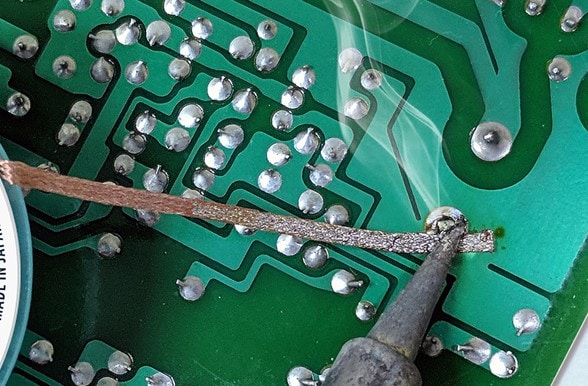


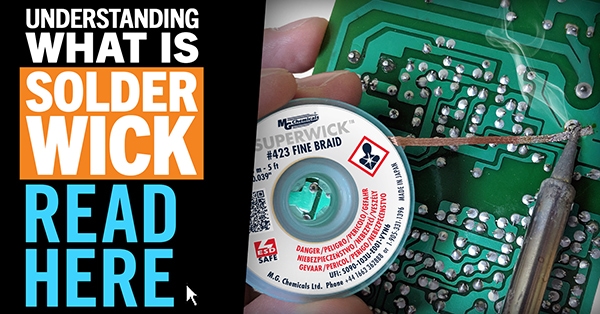




Circuit designers agree tools like solder wick are critical towards maintaining the performance of PCBs. Solder wick, wick or desolder braid is much like an eraser or whiteout, it acts as a means to remove mistakes from circuit design. Specifically, solder wick helps designers replace worn or damaged parts. It also allows fabricators to remove solder bridges and shorts.

Techniques Using Solder Wick
When removing solder, it is important to maintain contact between the soldering iron, the solder joint and the wick. For best results, we recommend using a chisel soldering iron tip. Also, remember to remove the wick from the solder joint when you remove the tip, otherwise, the wick tends to stick to the solder. Simply put the solder iron tip back onto the wick and you can then remove it from the solder joint.
If solder becomes difficult to wick, one trick to help get the solder to flow up the braid is to add more solder to the joint. Adding more solder removes surface oxides from the additional flux which helps the solder from the joint flow more easily up the braid. It also acts as a heat bridge, heating the remaining solder so it melts and flows up the wick.
Components of Solder Wick
Desoldering braid is finely weaved copper wire with added flux. Good quality wick uses fine strands of copper wire. The Fine copper strands easily twist into a tight weave, providing better heat transfer and capillary action. The copper strands in the braid are highly thermally conductive, helping to transfer heat to the solder, keeping it liquid.
The ideal solder iron temperatures depend on the type of solder to remove. For most users, 315°C seems to work well for many solder types. Make adjustments to the solder iron temperature to boost solder flow, while preventing unwanted damage to the PCB.
Most solder wicks come with flux added. Typically, the flux is enough to get the liquid solder to flow through the braid. In some instances; however it is helpful to add flux to the braid by simply dipping it in flux. The added flux improves removal of surface oxides which makes it easier for the liquid solder to flow.
Types of Solder Wick
The type of flux added to the solder wick is mainly what defines solder wick. The types of flux are the same as what you’d expect in solder wire or paste. These include rosin flux, no-clean and resin flux. Also available is solder wick which has no flux added to the braid. Note that users of this type of braid must add flux to get the solder to flow.
Solder Wick Packaging
Many solder wicks sell in ESD safe bobbins. The ESD does not refer to the solder wick, it refers to the plastic packaging. These bobbins do not hold static charge, lowering risk of discharge during soldering that can damage circuit components.
Solder wick comes in many different lengths and widths. When choosing wick, use a width that closely matches the width of the area with solder. The length of the solder wick roll governs the amounts of solder you can remove with a single roll. Simply cut away wick that’s full with solder during use so the braid continues to remove solder.
With the solder now removed, the component becomes easy to remove and replace. MG Chemicals has a variety of solder wick available depending on your needs. Our braid comes in multiple flux types including no-clean and sizes.
|
Series |
Flux Type |
Available Width (mm) |
|
RMA |
1 to 3 |
|
| 400-LF |
ROL0 |
1.5 to 2.5 |
|
ROL0 |
1.5 to 2.5 |
|
|
None |
1.5 & 2.5 |
Table 1: Comparison of MG Chemicals Desoldering Braid Products