Product Categories
New Product
Epoxy Potting Compounds
Featured Product
Soldering Flux

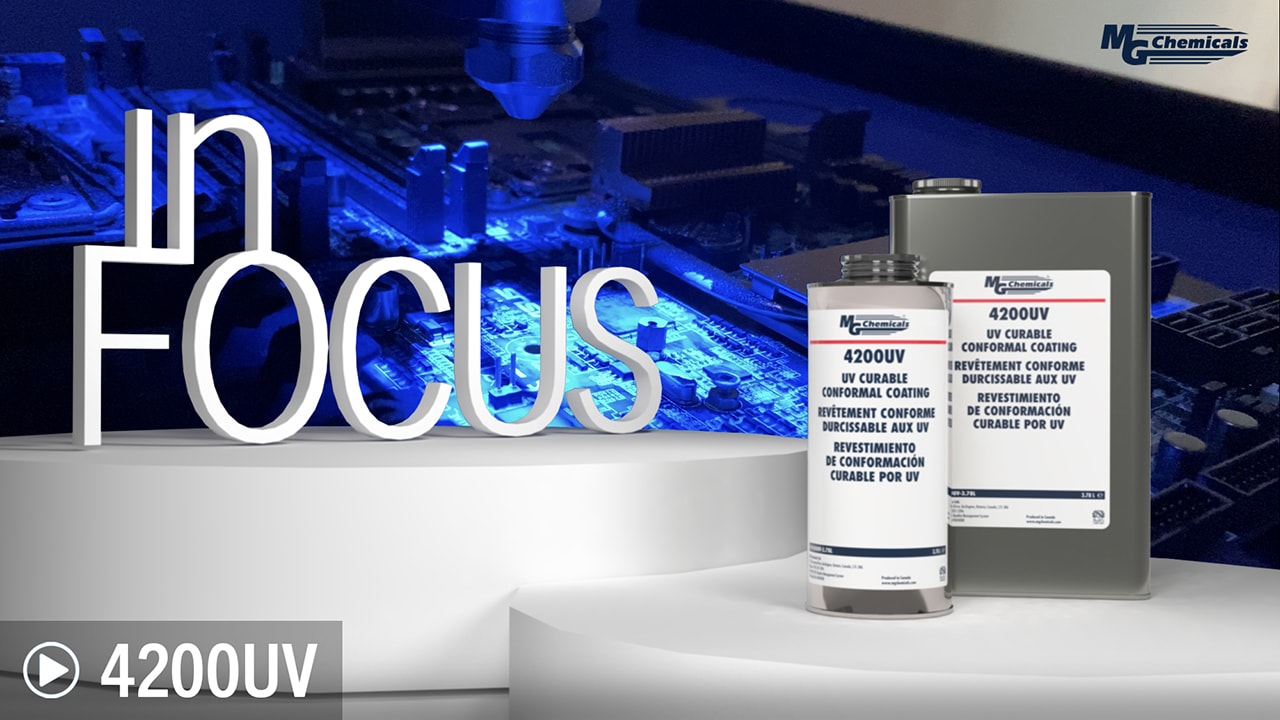
UV curable materials are composed of liquid monomers and oligomers functionalized with epoxy, polyurethane or polyester groups, which provide enhanced properties once cured. Photo-initiators are blended into the resin mix, which photo-degrade when exposed to certain wavelengths of light, forming free radicals that quickly cure the resin system.
Many industries take advantage of rapid cure UV systems that facilitate high throughput and quick turnaround. Many inks for magazines contain UV curable materials that enable the speedy throughput demanded by the print media industry. Fiber optic cables used in telecommunications are manufactured at speeds of nearly 3000m/min, so rapid cure protective UV coatings are absolutely essential.
UV curable materials do not cure by conventional means like drying. Rather, they are activated by exposure to certain wavelengths of light. With UV systems, we must familiarize ourselves with specific terminology so we can grasp what is required to achieve full cure.
Ultraviolet Light – UV light comprises the range of wavelengths (known as a band or spectrum) from about 100-400nm. This spectrum is typically broken down further into three more narrow spectra: UVA (315-400nm), UVB (290-320nm) and UVC (100-280nm). Different photo-initiators react at different wavelengths, so it is important to know which band a particular UV system reacts to, so that the correct lamp can be used.
Irradiance – Irradiance is a measure of the light intensity striking a surface, and is measured in W/cm2. Higher irradiance lowers cure times, as high intensity radiation more efficiently activates photo-initiators, which begin crosslinking in the resin. Irradiance can be measured with a simple radiometer, used to monitor a lamp’s output over time.
Dose – Dose is the amount of time (in seconds) that a UV system must be exposed to a particular irradiance to achieve cure, and is measured in J/cm2. The formula below shows the relation between irradiance and dose:

Below is a sample cure schedule for a typical UV material:
|
|
UVA |
UVB |
UVC |
|
Irradiance (W/cm2) |
1 |
0.7 |
0.5 |
|
Dose (J/cm2) |
3 |
4 |
6 |
|
Time of exposure (s) |
3 |
5.7 |
12 |
Conventional cure lamps use a broadband spectral output light to cure UV systems. It is important to match the lamp type with the UV system to ensure a full cure. Traditional H-type Mercury vapor lamps have a spectral output of 220-320nm, and are ideal for thin layers and clear coats, whereas D and V-type lamps are better suited to pigmented systems and thicker coating layers. Light Emitting Diodes, or LEDs, are a special family of lamps that have a very narrow output band of 10nm or less. These lamps offer significant cost savings over conventional lamps due to their lower energy output, which has led to the formulation of many new coatings, inks and adhesives tailored to LED curing systems.
At first glance, using a UV coating might seem prohibitively expensive, as these products come at a considerably higher price than more traditional solvent-borne coatings such as acrylics, polyurethanes and epoxies. But estimating the true cost of these coatings requires a more in-depth analysis. To make the case for UV coatings, let’s consider a simple PCB measuring 4” by 6” and standardize the dry film thickness to 2 mil (50.8 µm).
|
|
Cost/L |
Surface Area (cm2) |
Coverage @ 50µm (cm2/L) |
Total Parts Coated |
Cost/Part |
|
UV Coating |
$200 |
155 |
176,620 |
1140 |
$0.17 |
|
Solvent Coating |
$65 |
155 |
45,354 |
293 |
$0.22 |
The cost difference between the two coatings is due to the fact that the solids content of the UV coating is 96%, compared to the solvent-borne coating, which contains only 29%. The UV coating is therefore much more efficient, as almost all of the material applied to the board remains after curing, compared to the solvent-borne system, 70% of which evaporates and is not part of the cured film.
The biggest drawback with respect to the cost of using UV curable materials is the high initial capital investments required. Radiometers, conveyors, lamps, and specialized dispensing equipment are not cheap, so serious cost-benefit analysis is required before considering these materials.