



Customer Challenge
While the surge in popularity for drones was driven largely by the DIY community as a recreational hobby, Drones are now used in many different businesses such as agriculture and film to save both time and money. First aid responders are no exception, with drones now being deployed in emergency situations such as car accidents, fires and emergencies in remote, isolated locations. Such specialized drones are fitted with advanced equipment such as 4K cameras, GPS, 2-way comms, night vision, thermal sensors and mesh network relays. This equipment, coupled with the extended flight range of these drones, requires batteries that can hold substantial charge; however, thermal management now becomes an issue to prevent runaway heat. Thermal management materials like thermally conductive adhesives present designers with a turnkey solution to help prevent hotspots and subsequent overheating. Finding the right solution for your application however requires consideration of other features such as cure speed, flame retardance and material consistency. For the customer, the challenge was finding a fast-set, flame retardant, thermally conductive epoxy adhesive that easily spread over various circuit chips like CPUs and GPUs to bond heat spreaders.
Key Customer Requirements
- Fast-set adhesive. Sufficient green strength in under 15 minutes
- UL94 V-0
- Thermal conductivity > 0.6 W(m·k)
- Semi-flowable consistency
Solution
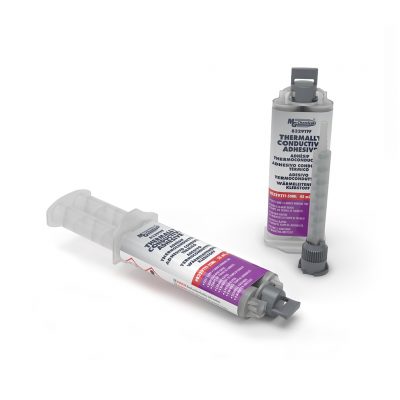
MG Chemicals’ 8329TFF is a 2-part, flame retardant, thermally conductive epoxy adhesive with a working time of just 5 minutes. Its short working time enables a high throughput in production where parts can be handled within 15 minutes after applying the adhesive. Further, its flowable consistency allows the adhesives to spread evenly over larger surfaces, ensuring minimal gaps when bonding heat sinks and thus mitigating the risk of localized hot spots and overheating.
Conclusion
Batteries that operate first responding drones power many special features including cameras, sensors and communication systems. The energy output required to power these devices also produces lots of heat which needs to be properly shuttled away from the battery to prevent overheating and malfunction. Adhesives like 8329TFF help eliminate localized hotspots within the battery structure to ensure continued performance.