
Home > Products > Conformal Coatings > Silicone Conformal Coatings
Silicone Conformal Coatings
MG Chemicals produces a range of silicone conformal coating products that offer enhanced heat resistance compared with other chemistries. These 1-part systems are fast curing, flexible and flame retardant, making them a suitable choice for many applications that experience a wide operating temperature range. These products are available in a variety of packaging options, ranging from aerosols to bladder packs, so they can accommodate almost any processing need.
We also offer acrylic, epoxy, polyurethane, and uv conformal coatings.
Features & Benefits
- Certified UL746E
- Certified IPC-CC-830C
- Easy UV light inspection
- Wide operating temperature range
- Validated for use with selective coating equipment
- Excellent resistance to salt water and corrosive gases
Applications
- Aerospace and transportation
- Circuits in marine environments including salt water
- RC circuits and drones
- Outdoor signs and displays
422B – Silicone Modified Conformal Coating – A silicone/acrylic hybrid conformal coating that dries quickly. UL94 V-0 rated.
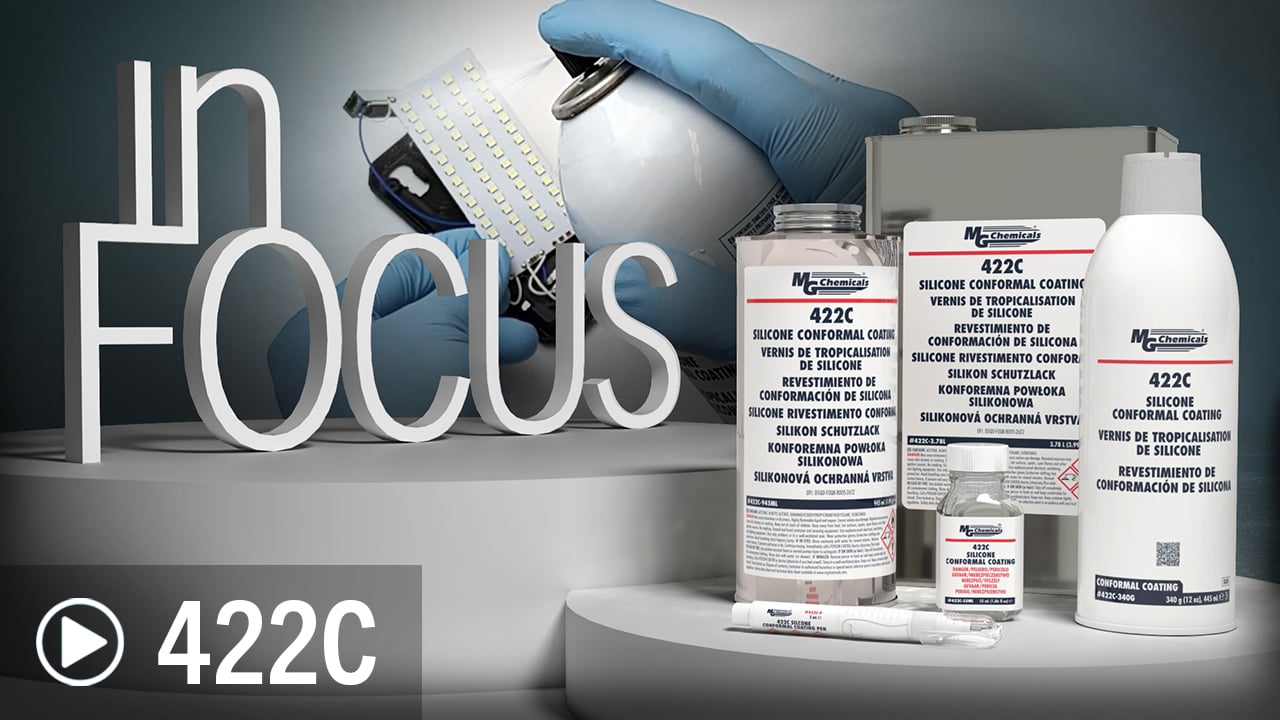
422C – Premium Silicone Modified Conformal Coating – A silicone/acrylic hybrid water-resistant conformal coating. UL94 V-0 rated.
ECC3011 – Solvent-Free Conformal Coating – A low viscosity, fast cure, flexible silicone coating that is UL746E certified, with excellent corrosion resistance.
ECC3051S – Solvent-Free Conformal Coating – A higher viscosity, 100% solid silicone flexible protective coating suitable for coating damming and thin section potting.
Technical Documents
Silicone Conformal Coating FAQs
Drones are constantly exposed to moisture and humidity from atmospheric condensation, snow, rain, and dew, which may short out their various circuits and cause malfunction. Fortunately, silicone-based conformal coatings such as MG’s 422B and 422C provide an easy way to protect your drone. By simply coating the different circuits – the flight controller, speed controllers, camera and so on – you can ensure that the drone will operate even when wet, and can continue its flights uninterrupted.
It depends on the extent of exposure. If the PCB is simply exposed to ordinary atmospheric moisture or intermittent splashes, a simple and practical solution is to coat the board using a conformal product that meets any additional requirements. For applications with extended moisture exposure or complete submersion, a more aggressive technique such as encapsulation should be considered.
422C is the newest addition to our conformal coating product portfolio. Like 422B, this coating is a silicone/acrylic hybrid coating that dries quickly leaving a smooth film that has a wide operating temperature range. It passed certification testing under the UL746E program as a resist coating from 25 to 75µm.
The 422C product was designed to replace the current 422B conformal coating that has been on the market for many years. While we know 422B has been a highly successful product with much positive feedback, the raw materials used to produce the coating have become more expensive over the years. Therefore, we decided to formulate a new product with similar performance at a lower cost.
Like 422B, 422C uses a blend of silicone and acrylic polymers that gives both the hardness and finish of an acrylic while providing the high temperature protection afforded by silicone. Both coatings are certified as UL94 V-0 under the UL746E designation and are low viscosity that is ready-to-spray. The table below compares properties of 422B with 422C.
|
|
||
|
Polymer Composition |
Silicone & Acrylic |
Silicone & Acrylic |
|
Solvent Composition |
Acetone and Aromatics |
Acetone and Esters |
|
Dry time to handle |
8 Minutes |
10 Minutes |
|
Service Temperature (°C) |
-40 to 200 |
-40 to 200 |
|
UL94 |
V-0, 20-30µm |
V-0, 25-75µm |
|
Viscosity |
10 cP |
14 cP |
|
Density |
0.90 g/mL |
0.92 g/mL |
|
% Solids |
28 |
30 |